
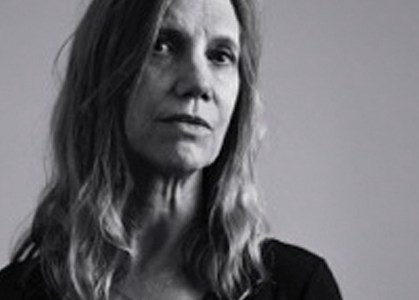
Linda Catlin Smith grew up in New York and lives in Toronto. She studied music in NY, and at the University of Victoria. She taught composition for many years at Wilfrid Laurier University in Ontario (1999-2020) and continues to teach privately. Her music has been commissioned, performed and/or recorded by: Goeyvaerts Trio, Psallentes, Tafelmusik, Victoria, Kitchener-Waterloo and Vancouver Symphony Orchestras, Arraymusic, Thin Edge Collective, Continuum, Tapestry New Opera, Via Salzburg, Evergreen Club Gamelan, Exaudi, and the Penderecki and Bozzini string quartets, as well as by soloists including Eve Egoyan, Philip Thomas and Elinor Frey. She has had performances at the Tectonics Festival in Glasgow (2017), Huddersfield Festival (2017), Principal Sound Festival (London, 2018) and Louth Contemporary Music Festival in Ireland (2019, 2023).
The BBC Proms commissioned a new orchestral work (Nuages) premiered in 2019 by the BBC Scottish Orchestra. Several solo discs of her music have been released: Thought and Desire, with Eve Egoyan, Ballad(Eve Egoyan and Andrew Smith), Meadow with Louth Contemporary Music Society; and five recordings: Dirt Road, Drifter, Wanderer, Among the Tarnished Stars (with Messiaen’s Quartet for the End of Time) and Ballad, on the ‘another timbre’ label. Dark Flower is just out featuring the Thin Edge New Music Collective. Some of her works are now available through Composers Edition.
THE QUESTIONS
What is your earliest musical memory that, in looking back, has proved to be significant regarding your career as a composer?
My earliest music memory is of sitting at the piano, playing the keys and listening. I was young enough that I could not yet reach the pedals. The piano was like a magical box of beautiful sounds. When I was about 5years old I was given a small record player in my bedroom, and I was allowed to listen to one side of an lp recording every night, choosing from my parents’ classical and jazz records. There was something so wondrous about listening to music in the dark: nothing to see, just surrounded by sound.
Are there composers who have been influential or relevant regarding your own work? Has this changed over time?
As a child and teenager I loved: Ravel’s L’enfants et les sortileges, and his Pavane, Debussy’s La Mer, Stravinsky’s Rite, Charles Ives Three Places in New England, Prokofiev’s Romeo and Juliet. I played a lot of folk music (on flute) in my teenage years – especially Irish and Appalachian folk tunes – and that sound world was formative for me: the light textures, the modal harmonies, the constantly varying repetition… In university I fell in love with Webern’s op. 21, Cage’s second string quartet, Feldman’s False Relationships and the Extended Ending. I also loved early music – listening and playing (I trained in harpsichord at university), especially Rameau and Couperin. I loved the vocal music of Josquin des Prez and Dufay. I still love all of these, but I’m always curious to listen to things I’ve never heard, to listen to the music of my composer comrades, to hear something I’ve never heard before. I like to be aurally confused, I love to be astonished.
How do you approach the question of “form” especially for longer works?
Form is something that comes in the process of writing. I don’t plan forms, even for long works. I more or less discover the form of the piece in the process of writing; it’s only when I’m quite far along in a piece that I start to have a feeling for its form. It’s an intuitive thing for me. I’ve written a number of longer works: Ballad is 45 minutes, Meadow and Dark Flower are both a half hour, and two new pieces – The Plains and Dandelion – are both an hour. I don’t usually write in movements, though I do have one long piece in 15 movements (Dirt Road); usually I just allow the piece to unfold over a longer period of time, sometimes circling back to material, sometimes just carrying on, like moving through a landscape. In longer works, I like to see how long I can keep something going, to dwell in material for a longer time.
Would you mind speaking a little concerning your working process, i.e., do you have a regular schedule for writing; do you use a computer for composing (either for creating pre-composition materials or notation), if so, do you find that it inhibits your process? What other technology, if any, do you use?
I compose whenever I have some time. Sometimes I’ll check in on the piece I’m writing several times a day. I work until I hit some kind of a wall, and then I wash the dishes or weed the garden and think about it from a distance. Sometimes I focus on a small problem – figure out a voicing, or a register, or a chord, focusing on small tasks rather than thinking about the big picture. I fool around with material a lot – I try things one way, then another. I think about the work I’m writing a lot – often I find myself thinking about a piece as I’m walking, or before sleep at night. This ruminative process often gives rise to something I want to try the next day.
I work at the piano, with paper and pencil (I like to use very wide staff paper, and I love soft pencils). I work at the piano because it keeps me in the process longer, and it also keeps me aware of sound in real time and space, as opposed to in my head. In the past 8 years or so, I’ve put most of my scores onto the computer at the end of the process, when the composing work is finished. But my best thinking is usually done with a pencil in my hand.
Please describe a recent work and provide a link to a video/audio clip.
Meadow is in a series of short sections. Sometimes the material is melodic, at other times the melody is hidden, shared between the instruments, and there are some passages that are simply chords. For me, a meadow is a simple place, with elements that are there quite naturally; it’s not a spectacular garden, but if you look closely there are many different types of plants and tiny flowers. It is a place of infinite variation.
I’m fascinated by harmony, not functional harmony, but what I like to think of as new harmony. I like to hear harmony that moves in a direction not necessarily implicated by the material. I like to sit with things for a while, to dwell in the material, to have a chance to listen – whatever the aural equivalent word would be for ‘gazing’… I think that might be another relationship to the title. Another thing I like is the subtle coloration differences between the three instruments – they are shadings of each other, and they have their own distinct qualities, even when in the same register. I am drawn to this kind of colour saturation. These things all combine to take the music into what I think of as subtle emotions – shadings of emotion, perhaps; I often say music can touch on emotions we don’t really have names for. And yet, I hope at least, there is a kind of detachment here, too. The work is more like a patient observation of material than a form of self-expression. I try to keep myself out of it, and let it just be.

 Musica Kaleidoskopea